

These are two older photos that I have, but I think they do well for today.
My Photography || Flickr Friday Photo
My Photography || Flickr Friday Photo
 I found this quote on Justin Taylor's Blog and wanted to share it with you:
From The Cross in the New Testament by Leon Morris:
To put it bluntly and plainly, if Christ is not my Substitute, I still occupy the place of a condemned sinner. If my sins and my guilt are not transferred to Him, if he did not take them upon Himself, then surely they remain with me. If He did not deal with my sins, I must face their consequences. If my penalty was not borne by Him, it still hangs over me. There is no other possibility.--The Cross in the New Testament by Leon MorrisMay you all have a blessed Easter as you celebrate what Christ did for you on the cross and his triumph over death in his resurrection.
 Being that this is Holy Week, it seems like I should be writing something about Jesus and not Paul, after all this is the week that we, as Christians, celebrate what Jesus has done for us not only on the cross, but also in his resurrection. One we need to understand Christ's dying and rising as a dual event, where we cannot separate the two. Obviously Jesus could not have risen, without dying, but his death is validated by his resurrection. In other words, Jesus' death would have no implications for us if God did not then raise him from the dead.
For my class on Romans, this week, we arrived at Romans 6. In this chapter Paul explains that we as believers have died and risen with Christ. He then steps through what it means that we have taken part in this dual event of the cross and the resurrection. Paul carries this motif through much of his writings and is foundational not only in understanding Paul, but also in understanding our lives as Christians.
Robert Tannehill, in his book Dying and Rising with Christ, where he explains more fully what Paul's intent is, writes the following:
If the believer dies and rises with Christ, as Paul claims, Christ's death and resurrection are not merely events which produce benefits for the believer, but also are events in which the believer himself partakes. The believer's new life is based upon his personal participation in these saving events. Furthermore, these events continue to give their stamp to the life of the believer, for he continues to participate in Christ's death and resurrection in his daily life, especially through suffering.What Tannehill goes on to explain in the next 134 pages-- which read as if they were 800-- is that Paul finds it essential that we, as believers, understand that we have participated in the act of dying on the cross with Christ. And not only have did we die with Christ, we were also raised. We then are to live our new life with this as our structure. We daily have to reckon ourselves dead to sin-- it now has no power over us-- and live, as Paul writes, presenting our "members to God as weapons for righteousness" (Romans 6:13).
This first one is a classic that has been passed around the net the past weekend, so I give it to all.
And this, I declare, is the greatest six minutes and twenty-three seconds of television last week:
 There are a lot of places where North Park and I don't align. For the most part I'm fine with that. I've learned to pick my battles. I've learned about the correct arenas of those battles. I know that I'm not going to convince anyone in a classroom setting of my theological positions. I'm not worried about convincing people anymore, rather than an understanding of where I'm coming from, which usually means grabbing some coffee and sitting down for a patient conversation. And I've learned that blogging about something and thinking no one will ever read it is a false assumption to make. So I don't make that assumption anymore.
However, beyond our differences in theology-- my stance on women in ministry and my strongly held Calvinistic beliefs-- even the primacy with which I hold Scripture is dashed aside. When I talk about the Bible I use words like "inerrancy" and "infallibility." Language in these tones, however, never get used at North Park. Why would one refer to the Bible as inerrant? I thought we were so passed that.
Honestly I don't understand what people have to hold onto, if they don't affirm the inerrancy of Scripture. No, I'm not naive enough to say that there aren't inconsistencies and discrepancies between one book or another. Nor am I naive enough to say that stories and metaphors don't exist in the Bible. There are literary genres in Scripture. I also contend that Scripture is insufficient to describe the fullness of God's glory, but on this side of the mirror, this is as clear as we can see.
But more than all that, this is God's word. Are those who don't affirm the inerrancy of Scripture calling God errant? If we believe 2 Timothy 3:16, 17 that all Scripture is God-breathed, then what we today affirm as Scripture has come from the mouth of God, and unless one thinks that God makes mistakes, or errs, then I don't see how we can make the same claim on Scripture. But then again, 1 & 2 Timothy have authorship issues and who even gives a crap about what Paul says anyway. He wrote at a specific time to a specific people addressing a specific issue and we're not naive enough to think that this still applies to us today, do we?
What blows my mind is how the Covenant can use words like "perfect" to describe how the Scripture functions, but not affirm it's inerrancy. Who then decides what's errant or inerrant? How do we make these judgment calls? And then how do we explain to our flocks that this section of Scripture is right, but this stuff here is phooey, so don't believe that, cause that'd just be stupid. Do we ride the wave of culture to inform our consciences as to what is valid in God's word? I contend that is a dangerous wave to ride.
Are we really so bold before God to toss aside his word and tell the Creator that we're the ones that decide what is true or not?
 Everywhere I've been turning as of late, there has been an overwhelming discussion of the War in Iraq. Both Jon Stewart and Stephen Colbert had people on last night addressing the war. Newsweek's stories this week all focused on the soldier's lives lost. The network news programs took a break on the war in Iraq last night to tell us about the war on cancer, in response to both Edward's and Snow's diagnoses. But the conversation is never dead.
Should we be calling it a "war" or an "occupation?" Is it right? When should we leave? What would be the consequences of leaving? From what I've read there seems to be no good answer to this question and the default Democrat answer "pull out now" wins out, just by that--default. No one has a good solution.
I read how Pelosi got her antiwar vote in the House, and even though it will be vetoed, the Dems won. Won? Really? They got people to say what everyone has been saying the whole time-- wars suck. We don't want to war, but sometimes we have to. War has consequences and Newsweek illustrates that with their closing article Last Letters. It's a reprinting of deceased soldier's handwritten notes to their loved ones.
Everyone stands up at this point and says how horrible the war is for claiming American lives, but very few are arguing from the standpoint of the Iraqis. I contend that the best case scenario "pull out now" is racism-- and that's not a word I use lightly. Basic at it's premise is that we value American lives over Iraqis. We're tired of seeing our boys, sons, brothers and some sisters, dying to ensure the freedom of Iraqis. We're saying that American lives are more valuable than those of the Iraqis.
But what about their lives? What about their sons? What about their desire to live in a country where they don't have to worry about going to the market and being blown up by a bomb? Or living in a country that doesn't have an oppressive government?
I can't say that I love that we're over there, that we went over there or the results while we have been over there. But if we were all created in the image of God, then that imprint is on them as well. Their lives are as valuable as ours.
As much as we fight the war on cancer, we need to be fighting for the sanctity of all human life-- no matter where one lives.


I found some great videos about Facebook. If you don't know what that is, I can't help you, but maybe these can...
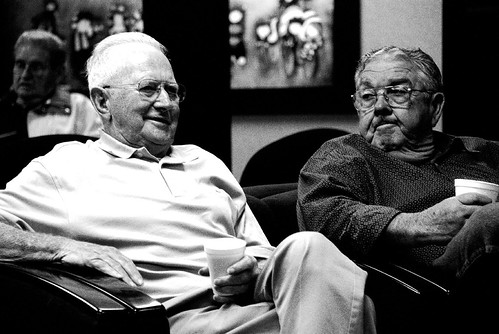
 The first is some older gentlemen waiting on their loved ones. The second is Foxy putting up with her loved ones.


