Showing posts with label church. Show all posts

Friday, December 19, 2008

Missional||Church

Chris has pointed out a great article by Alan Hirsch in Christianity Today's Leadership Journal that everyone should read. In the article, Hirsch rightly points out that missional theology applies to the whole life of the believer.

A missional theology is not content with mission being a church-based work. Rather, it applies to the whole life of every believer. Every disciple is to be an agent of the kingdom of God, and every disciple is to carry the mission of God into every sphere of life. We are all missionaries sent into a non-Christian culture.

Missional represents a significant shift in the way we think about the church. As the people of a missionary God, we ought to engage the world the same way he does—by going out rather than just reaching out. To obstruct this movement is to block God's purposes in and through his people. When the church is in mission, it is the true church.

In my current position, perhaps the most frustrating thing is that I am required to sit in an empty church building for approximately 30 hours a week. And while the word "missional" is continually described as what we are trying to accomplish, the fact of the matter is we are still expecting people to come to us. This is neither the way that God acted, nor expects us to act. Philippians 2:5b-8 reads,
Christ Jesus, who, though he was in the form of God, did not count equality with God a thing to be grasped, but made himself nothing, taking the form of a servant, being born in the likeness of men. And being found in human form, he humbled himself by becoming obedient to the point of death, even death on a cross.
And John 1:9-10a, 14,
The true light, which enlightens everyone, was coming into the world. He was in the world, and the world was made through him... And the Word became flesh and dwelt among us, and we have seen his glory, glory as of the only Son from the Father, full of grace and truth.
And the commission he gave us? I think you know where I'm going: Matthew 28:19, 20,
Go therefore and make disciples of all nations, baptizing them in the name of the Father and of the Son and of the Holy Spirit,teaching them to observe all that I have commanded you. And behold, I am with you always, to the end of the age.
But go read the article for yourself. And the Bible. And Kevin Cawley's Missional Church Beginner's Guide.

We'll talk after.

Don't call me.

I'll call you.

Friday, October 24, 2008

Friday Photo


Early this week my friend Chris and I met up at IKEA, so I could take back my flat-packed furniture I decided would just not hold all my clothes. Sad, I know. But after unloading the still boxed fake wood furniture, we hopped in Chris' car and headed north, leaving the city. It is a difficult task to leave Chicago. It takes effort and planning. Neither of which we really did. But with little more than some directions scrawled on a scrap of paper, we headed north in search of fall color and apples. We did find both, at a small little orchard, nearly sold out of many of the varieties already, near Sugar Creek, Wisconsin. We also found this little country church. It seems to have more property than the church that I'm currently at, and way more than the church I was previously a part of and the one that Chris still attends. It's great to see country churches still expanding and reaching the community around them. It would be great to see that where I am.

Wednesday, September 3, 2008

Church Website

A church without a website is a surprising thing. When I first got up to Chicago, I did my preliminary checks on churches in my area by getting on their websites. Some were better than others, but just that they had them gave me an idea of their existence.

All that to say, I just got on board with a church located near Midway in Chicago and they, er, we have no website. So my question goes out to all five of you reading this: What would you like to see in a church website? What would be your top five most desired elements? If you've created a church website before, what did you put into it? And finally, what should not be on a church website?

Tuesday, December 18, 2007

Dual Citizens, Pt. 7

Dual Citizens

Introduction
Part 2
Part 3
Part 4
Part 5
Part 6

Conclusion

I have tried to show in this paper that we need not a new way to think about the Church’s interaction with society, but a different one. Niebuhr’s typology no longer serves us adequately, because it is based in Christendom. First Peter, however, shows us that we live with a dual citizenship. We are both elect and exiled. We have an eschatological hope that is effected now in the communities in which we live outside of church walls. Our hope has public ramifications. I want to end with a final picture.

In his Sermon on the Mount, Jesus warns us to be salt. He says, “You are the salt of the earth, but if salt has lost its taste, how shall its saltiness be restored? It is no longer good for anything except to be thrown out and trampled under people's feet.”[1] This is the clearest picture to me. In my apartment, I have a ramekin filled with salt on my counter. It is always sitting there, ready so I can grab it when I need to season my food. I make sure it is always full. But with it sitting on the counter, it has no usefulness to me. It is only once I put it in what I am cooking when it becomes useful. As it dissolves in the boiling water or clings to the leaves of my salad, it becomes unperceivable to my eye, but it has a profound effect in the food that I eat. Since I began properly seasoning my food, I can immediately tell when something I eat is not properly seasoned. It lacks flavor and is not as dynamic as it could be.

It is the same for us as Christians. If we are not in and amongst society, we are not useful. We can no longer stay within our church walls, but we need to be in our communities living out our eschatological hope for the good of the city.

Bibliography

Achtemeier, Paul J. 1 Peter. Hermeneia. Minneapolis: Fortress Press, 1996.

De Neui, Paul. “Christian Communitas in the Missio Dei: Living Faithfully in the Tension Between Cultural Osmosis and Alienation.” Ex Auditu 23 (2007).

Legrand, Lucien. The Bible on Culture. Maryknoll, New York: Orbis Books, 2004.

McKnight, Scott. 1 Peter. The NIV Application Commentary. Grand Rapids: Zondervan, 1996.

Metzger, Paul. “Christ, Culture and the Sermon on the Mount Community.” Ex Auditu 23 (2007).

Michaels, J. Ramsey. 1 Peter. Word Biblical Commentary. Waco: Word Books, 1988.

Niebuhr, H. Richard. Christ and Culture. New York: Harper & Row, 1956.

Volf, Miroslav. “Soft Difference: Theological Reflections on the Relation Between Church and Culture in 1 Peter,” Ex Auditu 10 (1994): 16-27.

Winter, Bruce W. Seek the Welfare of the City. Grand Rapids: Eerdmans, 1994.


[1] Matthew 5:13.

Thursday, December 13, 2007

Dual Citizens, Pt. 6

Dual Citizens

Introduction
Part 2
Part 3
Part 4
Part 5

Part 6

What Peter does not call the believers to is separation. Throughout 1 Peter, he is calling them to a different style of living—one that does not move them out of society, but that changes the way in which they move through society. In 5:8, Peter explains that it is the devil who is our adversary and he is to be resisted, not society. Evil is not some impenetrable force outside the walls of the Church, but is personified in the devil as a lion that prowls around looking for someone to devour. Further, the believers are equally admonished to resist the desires of their own flesh. Ernst Troeltsch stated that, throughout history, believers typically operate in one of three ways: as a church, a sect, or a mystic.[1] He argues that the church operates out of grace, while a sect operates out of law. The church affirms the world, while a sect separates from it. He’s arguing that believing the Gospel has social implications.[2] On the basis of his thesis, not wanting to define the church as Troeltsch does, Miroslav Volf calls it a “soft difference.” Speaking of the Church, he writes:

It looked as if she did not forge her identity through rejection of her social environment, but through the acceptance of God's gift of salvation and its values. She refused to operate within the alternative “affirmation of the world” versus “denial of the world,” but surprised people with strange combinations of difference and acculturation. She was sure of her mission to proclaim the mighty deeds of God for the salvation of the world, but refused to use either pressure or manipulation. Rather, she lived fearlessly her soft difference. She was not surprised by the various reactions of individuals and communities among whom she lived because she was aware of the bewildering complexity of social worlds in which values are partly the same, partly different, sometimes complementary, and sometimes contradictory. And so it gradually became clear that the child who was born again through the resurrection of Jesus Christ from the dead into a living hope was not a sect at all. The unusual child who looked like a sect, but did not act like a sect, was a Christian community….[3]

A soft difference does not fully reject the culture around them, nor does it fully embrace it. Rather it is a difference that is lived out without fear of others living out their lives and a trust in the God that has elected them to their eschatological hope. Volf continues, “For people who live the soft difference, mission fundamentally takes the form of witness and invitation. They seek to win others without pressure or manipulation, sometimes even ‘without a word’ (3:1).”[4]

Volf brings up another key observation about the Christians in 1 Peter—they are to be a community. This may not be as shocking to us as it should be. We all affirm that the Church is made up of many people from all social strata—whether locally or globally. Throughout 1 Peter, he addresses them with the second person plural u`mw/n. Peter never addresses them as individuals, but corporately. Their lives are bound to one another in their election. Their conduct is not an individual one, but one that is thoroughly communal.

So what does all this mean for us living at the end of Christendom? First Peter teaches us that we need to change our model of Church. Practically, though, what does this mean? It means we need to inform the people who they are in Christ, what that means and how that affects their life. Simply put: preach the Gospel. Too many churches are caught up in getting people in the door with snazzy sermon topics and programs that they neglect the message of redemption found in the person of Jesus Christ. Peter preached in such a way as to affect his readers’ identity. He called them elect and exiles not to entertain them, but to teach them who they have become in Christ. We must preach the new identity our congregations have in Christ. Further, we need to move away from programs that keep people inside the walls of the Church. The Church is not programmatic or structural, it is people. Grace Chicago, the church that I am apart of, purposely does not fill its members’ schedules with church-bound activities, so that they can live their hope out in their communities.

Living in the communities also means seeking the good of them. This is what Jeremiah 29:4-7 instructs. Peter uses another word: blessing.[5] Desire and work for community improvements. Desire that others have adequate housing, schools, social support. I hesitate to give specific examples, because of the variety of communities that abound. But let it suffice to say that whatever you desire for yourself and your family, should also be desired for others.


[1] The mystic category, not being a part of the discussion, will be left untouched.

[2] Volf, 15, 16.

[3] Volf, 27.

[4] Volf, 24.

[5] 1 Peter 3:9.

Sunday, November 4, 2007

Book: Why Men? (Ch 1)

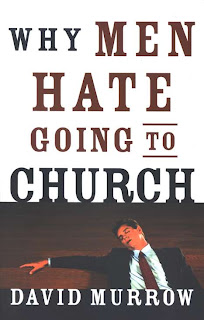
Last week we went started taking a look at David Murrow's book Why Men Hate Going to Church? Now we're moving into chapter 1.

Murrow starts out with a "case study"-- which I use loosely-- about a man named Cliff. He's a hard worker, fishes, loves his wife and kids, drives a four-wheeler, enjoys cold beer, dirty jokes and doesn't go to church. Murrow argues that guys like Cliff are practicing their own religion called Masculinity [He uses this term a lot, but has yet to really define it]. Murrow quotes two men, notably Charles Spurgeon, who says, "There has got abroad a notion, somehow, that if you become a Christian you must sink your manliness and turn milksop." Christianity and masculinity do not go together [as popularly perceived].

Is Church a women's thing? On the outset, Jesus, a man, founded the Church with 12 male disciples and, to our knowledge the whole of the NT is written by men. Today when you look at the pastorate most are males. However, when we begin to look at the congregation, the majority are women. Further, those who are volunteering and most involved are women. Murrow offers this sad statement: "the only man who actually practices his faith is the pastor."

He argues that this affects the women as much as men.

The men we do find in church are not the "manly men" like Cliff (see above), but instead are "humble, tidy, dutiful, and above all, nice." This is a contrast with those men we see in the Bible-- Moses, Elijah, David, Daniel, Peter, and Paul [and Jesus?]. They were "men who risked everything in service to God...They had an intense commitment to God, and they weren't what you called saintly."

Murrow states that this is a book written for laywomen. He asks if they will allow men to take risks, dream big, push the envelope.

I ask this: Murrow states that one "cannot have a thriving church without a core of men who are true followers of Christ." Is this true? Why or why not?

Thursday, November 1, 2007

Book: Why Men?

There's a book case behind the reference section in the library at North Park that holds the yearbooks from classes past. As this has no interest to me, the top of the hobbit-sized shelf is where I float over to when I'm looking to put off the necessary reading at hand. See, it is here that the newest books that have come into this compendium of knowledge start and I oft find something to divert my attention from my task at hand.

This week there were a couple books that caught my eye and one that I thought would be interesting to walk through on the blog. David Murrow, a Presbyterian (USA) from Alaska, who has had his hand in producing anything from the Discovery Channel to Dr. Phil, has put out a book entitled Why Men Hate Going To Church. I'll be honest, I've never heard of the guy, but I thought his book would be an interesting read no matter. It seems to look at facts and statistics, rather than our inner drive as men-- at least that's the appearance.

Murrow says that he's often wondered about why men hate going to church. He's seen it in all denominations. Those that do attend he states are "passive, bored or uneasy" (vii). How was a faith that had been started by a Man and entrusted to 12 men, so lacking in men today? As he looked around for answers, he didn't find any at the local Christian bookstore, so he decided to write the book himself. He claims neither to be pastor nor theologian, just a regular guy in the pews who is struggling to find his place in church (viii).

Before we delve into Murrow's search for the answer, what is the consensus of why men don't go or hate going to church? What has been your experience with men and church?

Tuesday, June 26, 2007

Solid Rock


There's something about song that is different than regular speech. It's easy to remember the lyrics to songs only having heard them a few times. Placing a rhythm and melody behind words somehow gives them force that transcends words that hang in the air with no tonal support. They tug at our emotions and bring us more fully into the full sense of the words that come out of our mouth. Most often, even if we can't meet the correct tones ourselves, we are struck by their depth of meaning.

The hymn writers, I think, had a strong sense to this. Edward Mote, desiring to write a hymn that explained the gracious experience of a Christian wrote "Solid Rock." We sang this at Grace a few weeks ago. The fourth verse struck me hard,

When He shall come with trumpet sound,
Oh may I then in Him be found.
Dressed in His righteousness alone,
Faultless to stand before the throne.
What lyrics, Christ-exalting or otherwise, get stuck in your head? Does it cause you pause when you get out of the car and Akon is the only thing banging around in there? It does me.

Tuesday, May 1, 2007

Free Book

The last thing that I want to do right now is to read another book, at least for the next couple of weeks. I about have a book to write in essays and that's before the exams and presentations I have to do. But I can't resist a free book, especially one that doesn't require any actual reading.

Christian Audio.com is giving away Richard Baxter's The Reformed Pastor in audio form. Upon check out all you have to do is type MAY2007 into the coupon line and start your mp3 download. The really neat thing is that they got Richard to read it. Pretty sweet really.

Monday, April 30, 2007

A (Banned) Word For Church Planters

From what I've read this video was shot for a church planting conference, but didn't get distributed because of some remarks made by a pastor of a certain church in South Barrington. Of course being contraband makes it much more prized and interesting than if it had been passed out to begin with. In it, Pastor Mark Driscoll talks about what it takes to be a church planter today.


Thursday, April 26, 2007

Sex and the Lies We Tell

One of the things that I truly enjoy about being at Seminary is the chance to hear some great speakers. A couple times a year North Park brings in Biblical scholars and theologians to speak on a variety of topics ranging from the Johannine literature to the Trinity. This time they brought in someone to talk about the Trinity, as well as the more interesting topic of sex--Lauren Winner.

Winner, a converted Jew, has written a few books, including one called Real Sex. I've only been able to read a couple chapters of Real Sex, but it's on the ever-extensive and constantly growing list of books to read. In her hour that she had today though, she spoke on the four lies the Church tells about extramarital sex, explicitly or implicitly.

  1. You'll feel bad afterwards. Youth pastors across America love to proclaim this, but in truth, there are many different emotions one may feel after sex ranging from elation to hung over. All sin promotes itself as being a pleasing and satisfying endeavor-- if the serpent had told Eve that she would feel bad after the apple, we would certainly be in a different place.
  2. While men are animals when it comes to sex, women have no sex drive. This is propagated with the purest of intentions of protecting our daughters against the sex-driven pubescent boy. The reality is that both men and women have sex drives. We need to educate accordingly.
  3. Premarital sex will leave you with scars and ghosts. While there are certainly consequences of having sex outside of the confines of marriage, we do not carry the ghosts of past sexual partners into our marriage beds.
  4. Marriage is the end all of sexual delinquency and final maturity into adulthood. All too often the Church promotes marriage as the final step into adulthood. Either through only choosing families to light the advent candles at Christmas or sitting the 28 year old single woman at the children's table, while the 24 year old married sibling is at the "adult" table, single Christians are left out of adulthood. Further, Winner spoke of marriage being another step in sexual formation with its own inherent struggles.
Winner pointed out that when the Church begins to talk about sex it always begins with the negative, when in fact God always declares sex to be good. And while the negatives are necessary to proclaim, the Church needs to extol the positive aspects of sex. Something else worth exploring that she touched only briefly on referred to people's thought that they govern their own bodies. She pointed out that in baptism we are joining our bodies to the body of Christ (also known as the Church) and we no longer, as if ever, have rights over what else to which we join our bodies. This seems to me a strong point of connection to begin to speak of chastity to post-moderns. The Church certainly should have a lot to say about the goodness with which God has created sex and we need to stop being drowned out by the culture around us.

Wednesday, April 11, 2007

Commun...

I've been meaning to write this post for a while now, which makes my next statement all the more true...

I've been thinking a lot about community lately--which communities I belong to, how community happens, etc. Off the top of my head I can think of a dozen communities that I belong to. Seminary, Albany Park, Chicago. Online, I'm on Flickr, Facebook, myspace (barely), Hi5 (Latin American myspace). I blog and that has a communal atmosphere. I just signed up for a photoblog, so we'll see how that goes. Most of these communities have small communities too. Groups and networks abound. I wonder at how real these communities are though. How much actual connection happens. I wonder if one can truly be connected to hundreds and thousands of people behind a keyboard and a glaring screen that is probably the reason I have to wear corrective lenses.

At the same time I think of my church, which I've been meaning to write about for a while now also. I love telling the story of how I found the church, because I feel like it really demonstrates God's providence.

After coming back from Costa Rica and still not being able to connect at the church I had been at before, I was pretty frustrated and started looking around. At the end of September I went up to Minneapolis for the Desiring God Conference. I talked with John Piper and Mark Driscoll and asked Justin Taylor also if they knew of any churches in Chicago. Acts 29 doesn't have any churches in Chicago. Back at my seat I was telling a good friend about it and a guy in the row behind me heard my frustrations. Before the session was over, he told me about a church in Chicago that a buddy of his started called Grace Chicago. Solid theology done in a bit different style than usual. If anything I'd at least go check it out.

I was compelled to go, and after to introduce myself to Pastor Bob. My fourth time there I was serving coffee. By far it has been the easiest community to get involved with. Grace meets in a local theater with a full bar being the center point when you first walk in. The worship is hymnic, but set to a consort of instruments (flute, violin, cello, guitar, percussion). There is a liturgy, which I haven't been used to in a while. Bob speaks in a way that engages the listener to the Gospel and pushes us beyond a comfortable Christianity that can be explained in 3 steps. But I think the thing that really binds us together as a community is the weekly taking of communion.

This is the first church I've ever been in that takes communion every week. Some argue that Eucharist would lose it's special status and become rote. Not so! It becomes extremely restorative to stand with the church and to remember and consume the body and blood of Christ. Never does it loose its meaning, but rather, when I am away I miss it so. Moreover, it is done with real wine and sourdough bread. I have long thought this is the way to take it, but never experienced it. The alcohol leaves the taste on your palate long after consumed, while the chewy bread has real substance to it.

Beyond all the OCD checking of Facebook, Flickr and my blog statistics, where I have found true community is where communion is taken. In it, the Church comes together and becomes the body of Christ, each doing its part and functioning to benefit the whole. Where the bond is not a school or network, but where Christ is the head is where real community is found.