Showing posts with label Books. Show all posts

Tuesday, April 28, 2009

Solomon Vs. Hugo

Solomon in Proverbs 31:4-31

An excellent wife who can find?
She is far more precious than jewels.
11 The heart of her husband trusts in her,
and he will have no lack of gain.
12 She does him good, and not harm,
all the days of her life.
13 She seeks wool and flax,
and works with willing hands.
14 She is like the ships of the merchant;
she brings her food from afar.
15 She rises while it is yet night
and provides food for her household
and portions for her maidens.
16 She considers a field and buys it;
with the fruit of her hands she plants a vineyard.
17 She dresses herself [5] with strength
and makes her arms strong.
18 She perceives that her merchandise is profitable.
Her lamp does not go out at night.
19 She puts her hands to the distaff,
and her hands hold the spindle.
20 She opens her hand to the poor
and reaches out her hands to the needy.
21 She is not afraid of snow for her household,
for all her household are clothed in scarlet. [6]
22 She makes bed coverings for herself;
her clothing is fine linen and purple.
23 Her husband is known in the gates
when he sits among the elders of the land.
24 She makes linen garments and sells them;
she delivers sashes to the merchant.
25 Strength and dignity are her clothing,
and she laughs at the time to come.
26 She opens her mouth with wisdom,
and the teaching of kindness is on her tongue.
27 She looks well to the ways of her household
and does not eat the bread of idleness.
28 Her children rise up and call her blessed;
her husband also, and he praises her:
29 “Many women have done excellently,
but you surpass them all.”
30 Charm is deceitful, and beauty is vain,
but a woman who fears the Lord is to be praised.
31 Give her of the fruit of her hands,
and let her works praise her in the gates.
Victor Hugo in Les Miserables:
Since her first appearance, the reader perhaps remembers something of this huge Thénardiess–for such we shall call the female of this species–tall, blond, red, fat, brawny, square, enormous, and agile; she belonged, as we have said, to the race of those colossal wild women who pose at fairs with paving-stones hung in their hair. She did everything around the house, the beds, the rooms, the washing, the cooking; and generally did just as she pleased. Cosette ws her only servant–a mouse in the service of an elephant. Everything trembled at the sound of her voice, windows, and furniture as well as people. Her broad face was covered in freckles, like the holes in a skimming ladle. She had a beard. She had the look of a market porter dressed in petticoats. She swore splendidly; she prided herself on being able to crack a nut with her fist. Apart from the novels she had read, which at times produced odd glimpses of the affected lady under the ogress, it would never have occurred to anyone to say: That's a woman. This Thénardiess was a cross between a whore and a fishwife. To hear her speak, you would say this was a cartman; if you saw her handle Cosette, you would say this was the hangman. When at rest, a tooth protruded from her lips.

Wednesday, February 6, 2008

P. 123

Tag has been a game that I have gone back and forth on in the previous years. It was a game that wanted to include you only to leave you out in the cold once you were it. Your disease infested being could infect others and all were trying to get a way from you.

Usher in the new age of computer tag, in which emails are passed around with feel good crap or high pressure stakes that push you into an eternal decision by how many people you forwarded on this heresy of an email.

Most recently I was tagged by Andy Kerr. Fortunately this form of tag is to include those around you and has nothing to do with your eternal salvation, but rather what you're reading.

The Rules:

  • Pick up the nearest book of 123 pages or more (no cheating!)
  • Find page 123
  • Find the first five sentences
  • Post the next three sentences
  • Tag five people
I waited till I had a cool enough book near me to prove that I have some gall. The book: God's Companions, by Samuel Wells, which I just received today from Amazon for the course Christian Ethics.
The practices of healing belong in relation to all the gifts of God explored in the foregoing chapters: healing takes its appropriate place as part of answering the call to be God's companions, to join the ministery of reconciliation. It is part of the transformation one can expect to grow out of justification and sanctification. Healing means exhibiting more of the fruits of the spirit-- becoming a witness to abundance rather than a herald of scarcity.

That said, I hereby tag:
  1. Chris Ridgeway
  2. Luke Johnson
  3. Kevin Cawley
  4. Joe Thorn
  5. Steve McCoy
Oh, and no tag backs.

Sunday, November 4, 2007

Book: Why Men? (Ch 1)

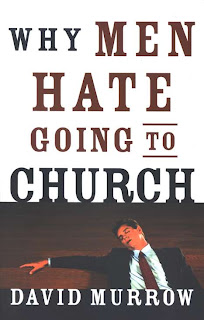
Last week we went started taking a look at David Murrow's book Why Men Hate Going to Church? Now we're moving into chapter 1.

Murrow starts out with a "case study"-- which I use loosely-- about a man named Cliff. He's a hard worker, fishes, loves his wife and kids, drives a four-wheeler, enjoys cold beer, dirty jokes and doesn't go to church. Murrow argues that guys like Cliff are practicing their own religion called Masculinity [He uses this term a lot, but has yet to really define it]. Murrow quotes two men, notably Charles Spurgeon, who says, "There has got abroad a notion, somehow, that if you become a Christian you must sink your manliness and turn milksop." Christianity and masculinity do not go together [as popularly perceived].

Is Church a women's thing? On the outset, Jesus, a man, founded the Church with 12 male disciples and, to our knowledge the whole of the NT is written by men. Today when you look at the pastorate most are males. However, when we begin to look at the congregation, the majority are women. Further, those who are volunteering and most involved are women. Murrow offers this sad statement: "the only man who actually practices his faith is the pastor."

He argues that this affects the women as much as men.

The men we do find in church are not the "manly men" like Cliff (see above), but instead are "humble, tidy, dutiful, and above all, nice." This is a contrast with those men we see in the Bible-- Moses, Elijah, David, Daniel, Peter, and Paul [and Jesus?]. They were "men who risked everything in service to God...They had an intense commitment to God, and they weren't what you called saintly."

Murrow states that this is a book written for laywomen. He asks if they will allow men to take risks, dream big, push the envelope.

I ask this: Murrow states that one "cannot have a thriving church without a core of men who are true followers of Christ." Is this true? Why or why not?

Thursday, November 1, 2007

Book: Why Men?

There's a book case behind the reference section in the library at North Park that holds the yearbooks from classes past. As this has no interest to me, the top of the hobbit-sized shelf is where I float over to when I'm looking to put off the necessary reading at hand. See, it is here that the newest books that have come into this compendium of knowledge start and I oft find something to divert my attention from my task at hand.

This week there were a couple books that caught my eye and one that I thought would be interesting to walk through on the blog. David Murrow, a Presbyterian (USA) from Alaska, who has had his hand in producing anything from the Discovery Channel to Dr. Phil, has put out a book entitled Why Men Hate Going To Church. I'll be honest, I've never heard of the guy, but I thought his book would be an interesting read no matter. It seems to look at facts and statistics, rather than our inner drive as men-- at least that's the appearance.

Murrow says that he's often wondered about why men hate going to church. He's seen it in all denominations. Those that do attend he states are "passive, bored or uneasy" (vii). How was a faith that had been started by a Man and entrusted to 12 men, so lacking in men today? As he looked around for answers, he didn't find any at the local Christian bookstore, so he decided to write the book himself. He claims neither to be pastor nor theologian, just a regular guy in the pews who is struggling to find his place in church (viii).

Before we delve into Murrow's search for the answer, what is the consensus of why men don't go or hate going to church? What has been your experience with men and church?

Saturday, July 28, 2007

Chicago Churches

One of my desires before I leave this great city fondly referred to as "The Chi" is to get out and take some shots of the churches here. A lot of them have been around for a long time and other's are just on the interesting side. But thankfully, if I don't get around to doing that, then I already have a book full of the pics that I never got! Borders, at least this location, currently has Chicago Churches: A Photographic Essay, by Elizabeth Johnson, on sale for $3.99. Granted, all the photos are not what I would define as churches, but rather "formalized" places of worship. Even so, it's a well put together photo essay that regularly runs at $45. So if you've ever wanted a coffee table book at less than 10% of the regular price, including tax, why don't you head on over to your local Borders.

Saturday, June 30, 2007

Quotable

Holden Caulfield on the Disciples:

I like Jesus and all, but I don't care too much for all the other stuff in the Bible. Take the Disciples, for instance. They were all right after Jesus was dead and all, but while He was alive, the were about as much use to Him as a hole in the head. All they did was keep letting Him down. I like almost anybody in the Bible better than the Disciples.
(Salinger, The Catcher in the Rye, 99)